Description
Module/Solution Overview
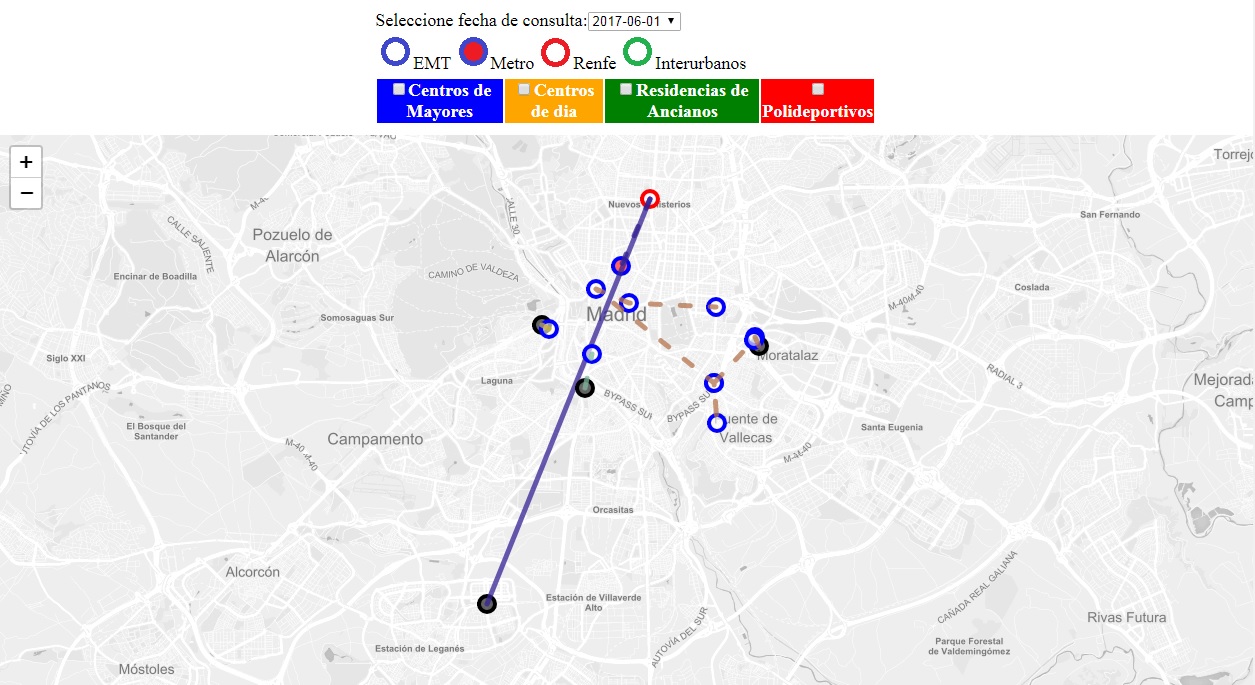
The City4Age Madrid pilot Application is an Android App that captures relevant information regarding the mobility of a user within a city, including: walking, usage of public transportation, going to regions or points of interest (such as markets, senior centres, cultural places, etc.). It mainly detects information outdoors, basically when the user is outside home. The App works together with 2 Bluetooth beacons responsible for collecting information on entry and exit of the participant's home. This avoids the storage of georeferenced sensitive information and more accurately obtains indoor location information.
The Madrid pilot App is responsible for collecting and processing all data of LEAs and measures, and sending them to the local repository which periodically sends them to the City4Age central repository. This App is currently being use in the Madrid pilot site.
Innovation
The City4Age Madrid pilot App main innovation is that it allows to capture outdoors information on the users’ behaviour in a transparent way for the user (the App runs in background and no interaction from the user is needed at all).
Business Impact
On one hand geriatricians, practitioners and professional carers may enhance their services to the elderly end-users by getting all this information about their patients or careers. As the information provided is “crude” it might be used in combination with a visualisation tool, such as the dashboard.
On the other hand, city service providers (such as public transportation companies) can benefit from this App in order to enhance the accessibility of their infrastructure and improve the services they provide.
The App itself is capable to detect behaviours only using sensors built-in smartphones. Additionally, more sensors can be added. However, if nothing else is used by the end-users the App will allow to identify behaviours. This represents a competitive advantage due to end users are elderly participants, who, in many cases, are not willing to use many devices. Also, it is important to note that usage of smartphones is increasing among elderly population.
Interoperability
The Madrid pilot App uses standard sensors and sources to get the behavioural information, such as Bluetooth Low Energy and GPS, and communicates using REST API. This means that it is interoperable and easily scalable if new sensors come to the market.
Stakeholders profile
Health related professionals that would like to monitor behaviours of patients or careers.
Sociologists and researchers that would like to analysed elderly behaviours, as such or as part of a bigger study to analyse, for example, wandering.
Cities’ administrators and city service providers to get information about their elderly citizens.
Competitors
So far there are a lot of Apps that get the physical movement of users (when training or during the day, taking into account the number of steps and distance walked, for example). But this only covers the physical mobility of the user within a city.
If we take a look at behaviours within a city, taking into account where the user goes, Google detects tentative behaviours according to your daily life activities.
The Madrid pilot App captures a combination of behaviours, analysed from a geriatric point of view that supports the identification of the frailty status of the users (e.g. reduction of motility, beginning of sarcopenia, etc.). This is not done so far (to the knowledge of the authors) with focus on elderly people.
Future availability
Maintained internal for research purposes.
The module will be extended to continue working on this research area.
It will be considered to publish any module under Open Source Apache License 2.0.
Partners involved
UPM (with support from CRTM for the integration with the public transportation network)
Contact info
Details
| Categories: | Pilot Applications |
UPM
UPM is the largest Spanish technological university as well as a renowned European institution. With two recognitions as Campus of International Excellence, it is outstanding in its research activity together with its training of highly-qualified professionals, competitive at an international level. More than 2,400 researchers carry out their activity at the UPM, grouped in 216 Research Groups, 10 Research Centers and 55 Laboratories, all of them committed to transforming the knowledge generated into advances applied to the production sector.