Description
Module/Solution Overview
The City4Age ontology model may be described as a specification of a conceptualization or a description of the concepts and relationships that may exist in the context of the City4Age project. It has been developed as an ontology-based model that integrates other modelling proposals generated in the context of the project to achieve harmonization among these models. This model has been designed reusing as much as possible the existing ontologies and vocabularies of related domains and linking it to DBpedia, Schema.org and other Open Datasets of the LOD cloud following Linked Data principles. As technical result, a model based on a network of ontologies for representing personal data and related information managed by City4Age information subsystems has been implemented. It also allows the implementation of queries to obtain the stored and inferred knowledge using the structured knowledge behind the ontologies.
Innovation
The City4Age ontology model has been developed from scratch applying a re-engineering approach to represent individual citizens’ data regarding personal and health profile, contextual data, performed actions and activities, behaviour, risk indicators and interventions in the context of City4Age platform.
Up to now, no other solutions integrating all this information are known.
Well-known ontology design methodology has been used to develop this solution, where the premise is to reuse, map and align already consolidated ontologies in related fields. Existing ontologies and vocabularies have been used where convenient, applying also Linked Data principles, in order to provide a standardized knowledge representation allowing its usage to third-party applications in the future. It also provides the capability of infer new knowledge using the structured knowledge behind the ontologies.
The solution is composed by a network of ontologies available from each corresponding URL for public inspection and comment:
- Personal Data Ontology includes most of the entities (personal, organic and health profile, including contextual data and performed activities) represented in the data model implemented for the Personal Data Capture subsystem.
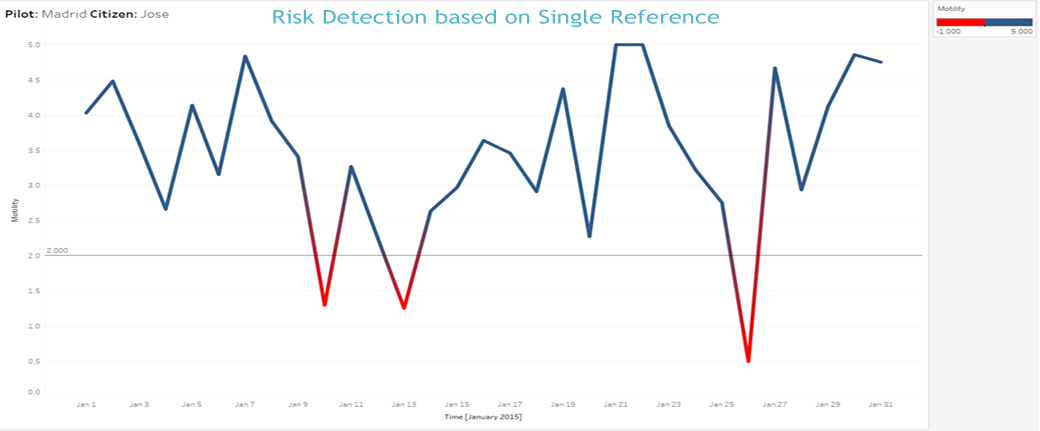
- Frailty and MCI risk detection ontology based on the data model about MCI/Frailty risk indicators for the Health Risk Detection subsystem.
- Intervention ontology based on the intervention model proposed for the Intervention subsystem. This ontology also imports a COM-B ontology developed to implement the COM-B model integrated in the proposed intervention model.
Business Impact
Organisations that are keeping individual citizens’ data regarding personal and health profile, contextual data, performed actions and activities, behaviour, risk indicators and interventions in the context of people’ activities monitoring can easily reuse the City4Age ontology model to enrich semantically their datasets and also to infer new knowledge using the structured knowledge behind the ontologies.
Health and Sports related apps and organisations that need to enrich semantically datasets about activities performed by their users, researchers, companies and public administrations working on citizens’ ageing based solutions can reuse the City4Age ontology model.
It also can be a source of knowledge for future projects based on citizens’ ageing.
Interoperability
Different applications supporting a common ontology can benefit from having a common understanding of the domain concepts and the data stored and produced by them. An ontology model allows the sharing and reuse of knowledge, so related applications can be written according to the commitment of using the vocabulary defined by a common ontology model.
In the City4Age context, the City4Age ontology model is used in the City4Age Linked Data Interface, one of the components of the City4Age Data Repository. One of the tools used to implement the Linked Data Interface component allows mapping the relational data to the network of ontologies of the City4Age ontology model and also other vocabularies. Another tool used to implement the Linked Data Interface component uses the output of the mapping process to infer new knowledge from the stored data using a rule engine reasoner that executes some rules based on the City4Age ontology model. The mappings are used to export data from the repository into standard formats using the vocabulary defined by the City4Age ontology model (network of ontologies). Since these data are served as triples of assessments generated using the mapping file and the structured knowledge behind the ontologies, it also allows the implementation of queries to obtain the stored and inferred knowledge.
Stakeholders profile
The City4Age ontology model incorporates the requirements provided by geriatricians, civil organisations and researchers from six different pilots with a variety of systems and applications, so it can be useful for other Health and Sports organisations, researchers, companies and public administrations working on citizens’ ageing based projects.
Competitors
Up to now, no similar solutions integrating all this information are known. Nevertheless, the City4Age ontology can be easily reused and expanded for third parties whenever is needed.
Future availability
The City4Age ontology is available on GitHub platform and licensed under the GPL license. It can be obtained and modified to improve it, or it can be adapted to a new project scenario.
Contact info
Details
| Categories: | Models and Algorithms |
UDeusto
Universidad de la Iglesia de Deusto
The University of Deusto, recently recognized as an International Excellence Campus, was founded in 1886 and comprises 6 Faculties: Psychology and Education, Human and Social Sciences, Engineering, Law, Business and Economic Sciences and Theology. The Deutotech - MORElab (http://www.morelab.deusto.es/) research group is one of the largest and most successful research groups in the University and belongs to the Internet unit within DeustoTech – Deusto Institute of Technology, affiliated to the Faculty of Engineering of the University of Deusto. The group has a strong background in the application of Artificial Intelligence techniques to middleware for embedded and mobile system in order to foster context-aware reactivity and activity modelling and reaction. In addition, the group is currently focusing its research on the area of Smart Cities by leveraging its expertise on Ubiquitous Computing, Linked Open Data management and recommendation and social data mining (Big Data Analytics) to extract structured data from social networks and thus enable urban apps and services assisting the daily activities of citizens or visitors.